
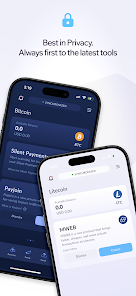
Can a single app really give you “privacy” across Bitcoin, Monero, and other coins? That sharp question matters because many users confuse convenience with private-by-design security. Privacy isn’t a binary feature you flip on; it is an interaction of cryptography, network choices, UX, device security, and user behavior. This article unpacks three common myths about wallets—especially multi-currency, privacy-focused apps—shows the mechanisms behind real protections, and gives US-based users decision-ready heuristics for choosing and configuring a wallet.
The practical case I use throughout is a modern multi-currency privacy wallet that supports Monero (XMR) and Bitcoin (BTC), offers built-in swaps, hardware integration, and air-gapped cold storage. That combination is powerful, but only when the constituent protections are understood and used correctly. Read on for mechanism-level explanations, precise trade-offs, and what to watch next.
Mục Lục
Myth 1 — “Open-source + non‑custodial means complete privacy”
Why people say it: Open-source code and non-custodial key storage are rightly valued: they mean you control private keys and external auditors can inspect the code. But the mechanism that produces privacy goes well beyond custody and visibility of source.
How privacy is actually produced: For Monero, privacy is largely on‑chain — ring signatures, confidential transactions, and stealth addresses obfuscate sender, recipient, and amount within the protocol. For Bitcoin, privacy is primarily about how you construct and publish transactions and which network paths expose your IP. A wallet that is non‑custodial and open-source provides necessary but not sufficient conditions for privacy: you still need network-level protections (Tor or connecting to your own node), transaction-level tools (Silent Payments/BIP-352, PayJoin), and careful UTXO management.
Key limitation and trade-off: Open-source visibility does not protect you from metadata leaks created by default behavior: automatic address reuse, broadcasting through centralized relays, or leaking device-level telemetry. The practical implication is that users who assume privacy because the app is open-source may under‑protect themselves—especially in the US where regulatory and platform pressures can influence service integrations like fiat onramps.
Myth 2 — “One seed phrase for all chains is simpler and as safe as separate seeds”
Why people say it: A single 12‑word BIP‑39 seed that deterministically generates wallets across multiple chains is convenient: one backup, one recovery flow. Many privacy-minded users welcome reduced cognitive load.
Mechanism-level reality: A single seed simplifies backup because deterministic wallets derive private keys for many supported chains from the same entropy. That is provably convenient. The trade-offs are about attack surface and compartmentalization. If the seed is compromised, every derived account on every chain is compromised. Conversely, separate seeds compartmentalize risk but increase backup friction and user error chances.
Decision heuristic: For normal balances, a single audited seed combined with hardware-enforced device security (Secure Enclave or TPM) and an air-gapped backup is reasonable. For larger holdings, split-compartment models—separate seeds for cold Monero holdings vs hot Bitcoin spending—reduce systemic risk at the cost of convenience.
How the wallet stack actually protects privacy: network, protocol, and device layers
Layered protections are not just academic: each layer mitigates different attack vectors. Here are the practical mechanisms and why each matters.
Network layer: Routing wallet traffic through Tor or connecting to a personal custom node prevents wallet IP address linkage to on‑chain events. For Monero this is especially important because, while the chain is private, node queries can leak which addresses you control if you use remote nodes. For Bitcoin, running your own full node or using Electrum over Tor reduces address broadcast linkage and reliance on centralized indexers.
Protocol and transaction layer: For Bitcoin privacy the wallet must support advanced transaction tools: Silent Payments (BIP‑352) create a static, unlinkable address for payers; PayJoin reduces linkage between inputs and outputs by making collaborative transactions, often lowering fees and increasing ambiguity for on‑chain analysis. For Litecoin, Mimblewimble Extension Blocks (MWEB) provide confidential transaction capability which changes anonymity assumptions for that chain.
Device and key protection: Device-level encryption (Secure Enclave, TPM), PINs, biometric gatekeeping, and two-factor methods protect keys from local compromise. Hardware wallet integration (Ledger series via Bluetooth/USB) shifts the signing operation off the potentially hostile host. For the highest assurance, air‑gapped cold‑storage sidekicks let you generate and sign transactions without network exposure.
Non-obvious insight: integrated exchanges and fiat on/off ramps change threat modeling
A convenient but underappreciated effect of built-in exchange functionality and fiat rails is that they create central chokepoints where private transaction flows meet regulated financial infrastructure. Mechanically, when a wallet offers instant swaps and credit‑card or bank fiat rails, the wallet or its partners must perform KYC/AML processes for fiat flows. That doesn’t mean on‑chain privacy is broken, but it means linkage between your identity and certain flows can be created off‑chain—especially when funds are converted to fiat. Users must treat on‑device swaps and onramps as separate threat vectors: the convenience gains are real, but they come with regulatory metadata collection that can deanonymize users when combined with chain analysis.
Three decision-useful heuristics for US-based privacy seekers
1) Map assets to use-cases: Keep spending coins (BTC/LTC) on wallets configured for coin control, PayJoin, and optional Tor, while storing large Monero balances in a wallet configured to use a private node and strong cold-storage practices. Mixing everything into one active wallet increases operational risk.
2) Treat network choices as primary: Always route wallet traffic over Tor for mobile wallets unless you control the node and network environment. Using a personal Bitcoin node or Monero daemon materially reduces the chance of remote node privacy leaks.
3) Hardware + air-gap for large sums: Use a hardware wallet for routine signing and an air‑gapped system (Cupcake-style sidekick) for high-value keys. The marginal effort for air‑gapped signing is small relative to the reduction in risk from host compromise.
Where this model breaks: limits, unresolved questions, and false assurances
Limitations to be explicit about: On‑chain privacy tools reduce linkability but do not erase it entirely. For Bitcoin, sophisticated chain- and network-level analysis combined with off‑chain identity data can still produce probabilistic links. For Monero, although the protocol is private by design, edge cases (wallet backups, third-party view keys, or remote node correlational attacks) can leak information. Built-in exchange features and fiat rails introduce off‑chain metadata that can defeat on‑chain privacy when combined.
Open questions and contested areas: Practical effectiveness of PayJoin depends on ecosystem participation—if only a few wallets support it, its protection is limited. The real-world privacy gain from Silent Payments depends on payer adoption and how merchants implement payment discovery. Finally, platform-level constraints (app store policies, banking partnerships) can shape what features are available in the US and how they are implemented.
Practical next steps and what to watch
If you are evaluating or configuring a privacy-first wallet today, here is a concise checklist: enable Tor or point to a personal node; use hardware signing for any sizable holdings; segregate seeds by purpose when amounts exceed your personal risk tolerance; enable Silent Payments/PayJoin and learn when each applies; and treat integrated on/off ramps as potentially deanonymizing—use them with caution.
For readers who want to explore a wallet that combines these features (Monero support, Bitcoin privacy tools, hardware integration, air‑gapped options, and built-in swaps), download pages and platform installers often include clear notes about network and node configuration—one convenient entry point for mobile users is this installer page for the wallet discussed here: cake wallet download.
FAQ
Q: If a wallet is open-source and non-custodial, do I still need Tor or a personal node?
A: Yes. Open-source and non‑custodial address control, not network metadata. Tor or your own node prevents IP-to-transaction linkage and remote-node query leaks. Without network protections, a passive observer can often connect your device to on‑chain activity even when keys remain local.
Q: Is one 12‑word seed phrase secure enough for all my coins?
A: It is secure in cryptographic terms, but not always the optimal operational choice. A single BIP‑39 seed simplifies backup, yet it centralizes risk. For routine daily amounts a single seed plus hardware security is practical. For large or institutionally significant holdings, compartmentalize across seeds and use air‑gapped cold storage.
Q: Do built-in exchanges compromise privacy?
A: They can. Integrated swaps and fiat rails improve usability but often require partner services that perform KYC/AML for fiat flows. If your goal is anonymity in practice, treat fiat conversions and centralized onramps as potential deanonymization points and use them with an understanding of the metadata they generate.
Q: How much privacy do PayJoin and Silent Payments actually give?
A: They increase ambiguity in common heuristics used by chain analysis. PayJoin conceals input ownership, and Silent Payments prevent simple address linking. Their effectiveness depends on adoption and correct wallet integration; they are tools, not silver bullets.
Final takeaway: Privacy is an emergent property of multiple layers. Choosing a wallet is not just about feature lists; it’s about how the wallet lets you control network paths, transaction construction, device key protection, and exposure to off‑chain identity systems. Use a layered model, test your backup and recovery paths, and treat integrated convenience features as trade-offs rather than unqualified gains.

TS.BS Vũ Trường Khanh có thế mạnh trong điều trị một số bệnh Gan mật như:
Gan nhiễm mỡ
Viêm gan do rượu
Xơ gan
Ung thư gan…
Kinh nghiệm
Trưởng khoa Tiêu hóa – Bệnh viện Bạch Mai
Thành viên Ban thường trực Liên chi hội Nội soi tiêu hóa Việt Nam
Bác sĩ đầu tiên của Khoa Tiêu hoá ứng dụng phương pháp bắn tiêm xơ tĩnh mạch trong điều trị xơ gan mạn tính
Bác sĩ Vũ Trường Khanh tham gia tư vấn về bệnh Gan trên nhiều kênh báo chí uy tín: VOV, VnExpress, cafeF…
Các kiến thức về thuốc điều trị viêm gan hiệu quả
